
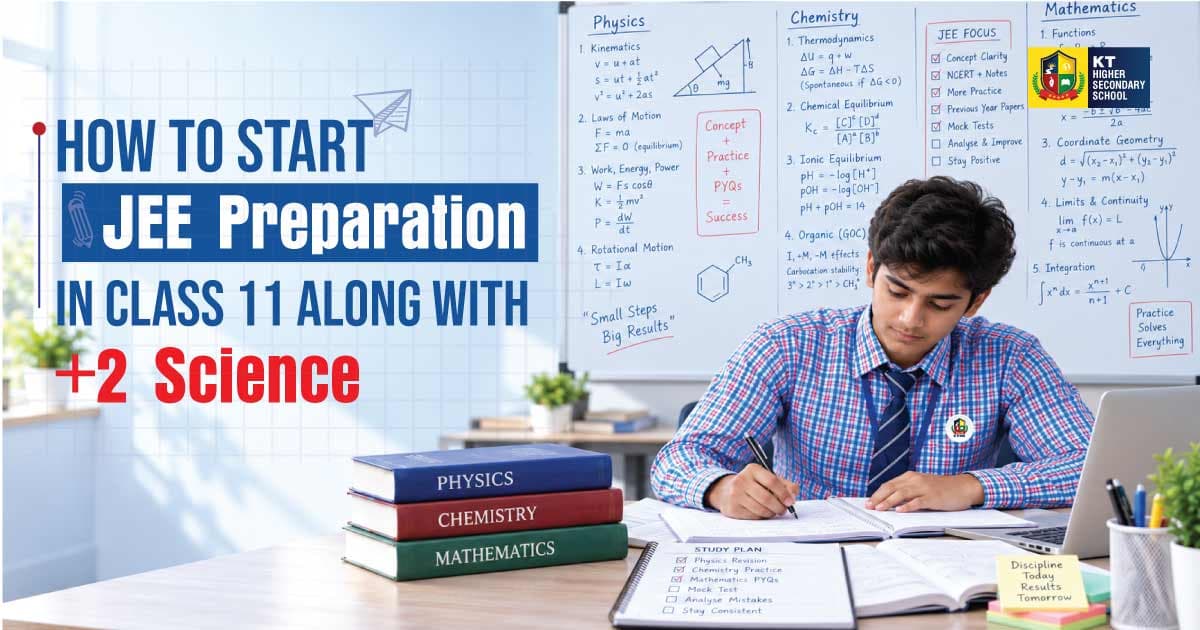
Starting JEE preparation in Class 11 can feel challenging, especially when you are also adjusting to the demands of higher secondary studies. However, the right approach can help you build strong concepts without feeling overwhelmed. Choosing +2 Science with JEE Coaching Bhubaneswar allows students to prepare for their board-level syllabus and JEE requirements together. With consistent study habits, regular practice, and proper guidance, Class 11 can become the right time to build a strong foundation for the engineering entrance journey.
The key is to understand that JEE preparation is not about studying for long hours every day. It is about learning concepts clearly, practising questions regularly, and managing your time between school and preparation. Students need an academic environment that supports both goals from the beginning. At KTHSS, students can explore an approach to higher secondary science education that helps them stay focused on their academic journey while preparing for future competitive opportunities.
Why Class 11 Is the Right Time to Start JEE Preparation
Class 11 is the ideal stage to begin JEE preparation because it gives students enough time to understand concepts without the pressure of last-minute learning. The Physics, Chemistry and Mathematics topics introduced in Class 11 form an important foundation for both Class 12 and JEE. Starting early also allows students to identify weak areas, practise regularly and gradually develop the problem-solving skills required for the examination.
An Integrated JEE Programme in Bhubaneswar can help students manage their +2 Science studies and JEE preparation in a more organised way. Instead of treating board studies and entrance preparation as completely separate goals, students can learn related concepts together and use their time effectively. With proper guidance, consistent practice and a clear study routine, Class 11 preparation can build the confidence and academic foundation needed for the JEE journey.
Understand the Class 11 Syllabus Before Planning for JEE
Before creating a JEE preparation plan, students should understand how the JEE syllabus connects with their Class 11 studies. JEE Main and JEE Advanced cover Physics, Chemistry and Mathematics, with many Class 11 topics forming the foundation for concepts studied later in Class 12. Knowing the syllabus early helps you plan your studies, avoid missing important chapters and give enough time to difficult topics.
Physics
Class 11 Physics introduces several fundamental concepts that are important for JEE preparation. Major areas include Units and Measurements, Kinematics, Laws of Motion, Work, Energy and Power, System of Particles and Rotational Motion, Gravitation, Properties of Matter, Thermodynamics, Oscillations and Waves. These chapters require strong conceptual understanding and regular numerical practice. Students should focus on understanding formulas, their applications and the relationship between different concepts instead of simply memorising them.
Chemistry
The Class 11 Chemistry syllabus is broadly divided into Physical Chemistry, Organic Chemistry and Inorganic Chemistry. Important areas include Some Basic Concepts of Chemistry, Structure of Atom, Chemical Bonding, States of Matter, Thermodynamics, Equilibrium, Redox Reactions, Organic Chemistry Basics, Hydrocarbons, Classification of Elements and Periodicity, and the s-block and p-block elements. Chemistry requires a balanced approach, with conceptual clarity for Physical Chemistry, strong fundamentals for Organic Chemistry and regular revision for Inorganic Chemistry.
Mathematics
Mathematics in Class 11 builds the problem-solving skills needed for JEE. Key topics include Sets, Relations and Functions, Trigonometric Functions, Complex Numbers, Quadratic Equations, Sequences and Series, Permutations and Combinations, Binomial Theorem, Straight Lines, Conic Sections, Limits, Statistics and Probability. These chapters are highly connected with later topics, making it important to develop a clear understanding from the beginning. Regular problem-solving is essential for improving speed and accuracy.
An Integrated JEE +2 Science Programme can help students study the Class 11 syllabus while connecting it with JEE-level preparation. The goal should be to learn each topic thoroughly during regular classes, practise questions at different difficulty levels and revise concepts consistently. When students understand the syllabus and its connections early, they can create a more practical preparation strategy for the two-year JEE journey.
How to Balance +2 Science Studies and JEE Preparation
Balancing +2 Science studies with JEE preparation becomes easier when students treat both as connected parts of the same academic journey. Instead of studying the board syllabus and JEE topics separately, focus on building strong concepts first and then practise questions at the required JEE level.
- Create a realistic daily timetable: Divide your study hours between schoolwork, JEE practice, revision and breaks. Keep the schedule practical enough to follow consistently.
- Complete school concepts first: Pay attention to classroom teaching because your +2 Science syllabus provides the foundation for many JEE topics.
- Practise JEE questions regularly: After understanding a chapter, solve JEE-level questions to learn how the same concept is tested in competitive examinations.
- Give equal attention to all three subjects: Avoid spending most of your time on your strongest subject. Maintain regular practice in Physics, Chemistry and Mathematics.
- Keep separate revision slots: Reserve time every week to revise formulas, concepts, reactions and previously solved questions so that older topics remain fresh.
- Use weekends for deeper practice: Use weekends to complete pending topics, attempt chapter-wise tests and work on questions that require more time.
- Do not ignore board preparation: Practise descriptive answers, derivations, diagrams and other board-specific requirements alongside your JEE preparation.
- Track your progress: Maintain a simple record of completed chapters, test scores and difficult topics. This helps you identify where additional practice is needed.
- Avoid studying only before examinations: JEE preparation requires consistency. Studying small portions regularly is more effective than trying to complete several chapters at once.
- Take regular tests: Chapter-wise and full-length tests help improve accuracy, time management and confidence while showing which concepts need revision.
Common Mistakes to Avoid During JEE Preparation in Class 11
Class 11 is when many students begin preparing seriously for the NTA JEE exam, but an unplanned approach can create gaps that become difficult to fix later. Students preparing through Science with JEE Coaching in Bhubaneswar should focus not only on completing chapters but also on understanding concepts, practising consistently and reviewing their progress.
| Common Mistake | What It Looks Like | Why It Can Affect JEE Preparation | Process to Avoid It | What Students Should Do Instead |
|---|---|---|---|---|
| Starting without understanding the syllabus | Beginning with random chapters based on what appears difficult or popular | Important topics may be missed, while too much time may be spent on low-priority areas | Begin by reviewing the latest official JEE Main syllabus and mapping it against your Class 11 syllabus | Maintain a subject-wise chapter checklist and update it as you complete each topic |
| Treating Class 11 as only board preparation | Studying mainly for school examinations and postponing JEE-level practice | Students may understand theory but struggle with application-based questions | After learning a school-level concept, gradually introduce JEE-oriented questions | Study the concept first, then move from basic to moderate and advanced problems |
| Trying to complete everything too quickly | Moving through several chapters without properly understanding them | Creates conceptual gaps that can affect connected topics later | Set weekly learning targets instead of chasing a large number of chapters | Complete fewer topics thoroughly and revise them before moving ahead |
| Ignoring difficult chapters | Continuously postponing topics because they feel complicated | Weak areas can accumulate and become harder to handle in Class 12 | Maintain a list of difficult topics and schedule dedicated revision sessions | Break difficult chapters into smaller concepts and seek help when required |
| Focusing on only one subject | Spending most study hours on Mathematics while neglecting Chemistry or Physics | JEE requires preparation across all three subjects | Allocate regular weekly study time to Physics, Chemistry and Mathematics | Give every subject consistent attention while adjusting time according to your weaknesses |
| Memorising instead of understanding | Learning formulas, reactions or shortcuts without knowing their application | Students struggle when questions are presented differently | Ask yourself how and why a formula or concept works before memorising it | Build conceptual clarity first and use memorisation mainly for facts that genuinely require it |
| Solving too few questions | Reading theory repeatedly but doing limited numerical or application-based practice | JEE requires students to apply concepts under time constraints | Follow every completed concept with structured question practice | Start with basic questions and gradually increase difficulty |
| Using too many books and resources | Switching between multiple books, videos, notes and question banks | Constantly changing resources can reduce consistency and waste study time | Select a limited set of reliable resources and finish them systematically | Prioritise school material, coaching material, NCERT where relevant and selected practice resources |
| Ignoring mistakes after tests | Checking only the score and moving on to the next test | The same conceptual or calculation errors may continue | Analyse every test after completion and classify mistakes | Maintain a mistake notebook covering conceptual, calculation, interpretation and time-management errors |
| Not revising Class 11 topics | Moving ahead after completing a chapter without returning to it | Previously learned concepts can become weak over time | Include weekly and monthly revision cycles in your timetable | Use short revision sessions, formula review and mixed-topic practice |
| Comparing preparation with others | Changing your schedule because another student studies more hours or solves harder questions | Can create unnecessary pressure and disrupt your own routine | Track personal progress rather than copying someone else's timetable | Compare your current performance with your previous tests and identify measurable improvement |
| Ignoring sleep and physical well-being | Reducing sleep to create more study hours | Poor rest can affect concentration, memory and sustained learning | Include adequate sleep and breaks in the preparation schedule | Treat rest as part of the preparation plan rather than lost study time |
How does KTHSS help in Preparing for JEE from Class 11?
At KTHSS, +2 Science with JEE Coaching Bhubaneswar is designed to bring board and entrance preparation together from Class 11. Students follow a coordinated academic plan covering Physics, Chemistry and Mathematics, supported by experienced faculty, regular assessments and personal mentoring. This approach helps students strengthen concepts, practise JEE-oriented questions and develop disciplined study habits without treating board and competitive preparation as separate goals.
Starting JEE preparation in Class 11 gives students two full academic years to build concepts, improve problem-solving skills and identify areas that need more practice. KTHSS supports this journey through integrated preparation, doubt clearance, remedial support and regular progress reviews. Students and parents looking to understand the available programme, subject combinations and admission process can submit an admission enquiry at KTHSS.
FAQs
Follow a structured timetable that combines school studies with regular JEE practice. Focus on understanding concepts, solving questions daily, revising completed chapters and taking periodic tests.
Yes. Several Class 11 concepts form the foundation for JEE and are connected to topics studied in Class 12. Strong preparation in Physics, Chemistry and Mathematics during Class 11 can make advanced topics easier to understand.
There is no fixed number of hours that works for every student. Instead of focusing only on study hours, maintain consistent daily preparation with focused study sessions, regular practice, revision and adequate breaks.
Students can manage both by connecting their board and JEE preparation wherever possible. A weekly timetable, proper prioritisation, regular revision and timely completion of assignments can help prevent academic pressure from building up.
Common mistakes include ignoring difficult topics, relying only on memorisation, using too many study resources, avoiding regular tests, neglecting revision and postponing doubt resolution. Building a consistent study routine can help avoid these problems.

KT Higher Secondary School
Start Your Science Journey with KTHSS
Looking for the best private +2 science college in Bhubaneswar with integrated JEE & NEET preparation? Contact KT Higher Secondary School today.
Apply Now For Admissions